
Disposable is not the flaw. It was intentional.
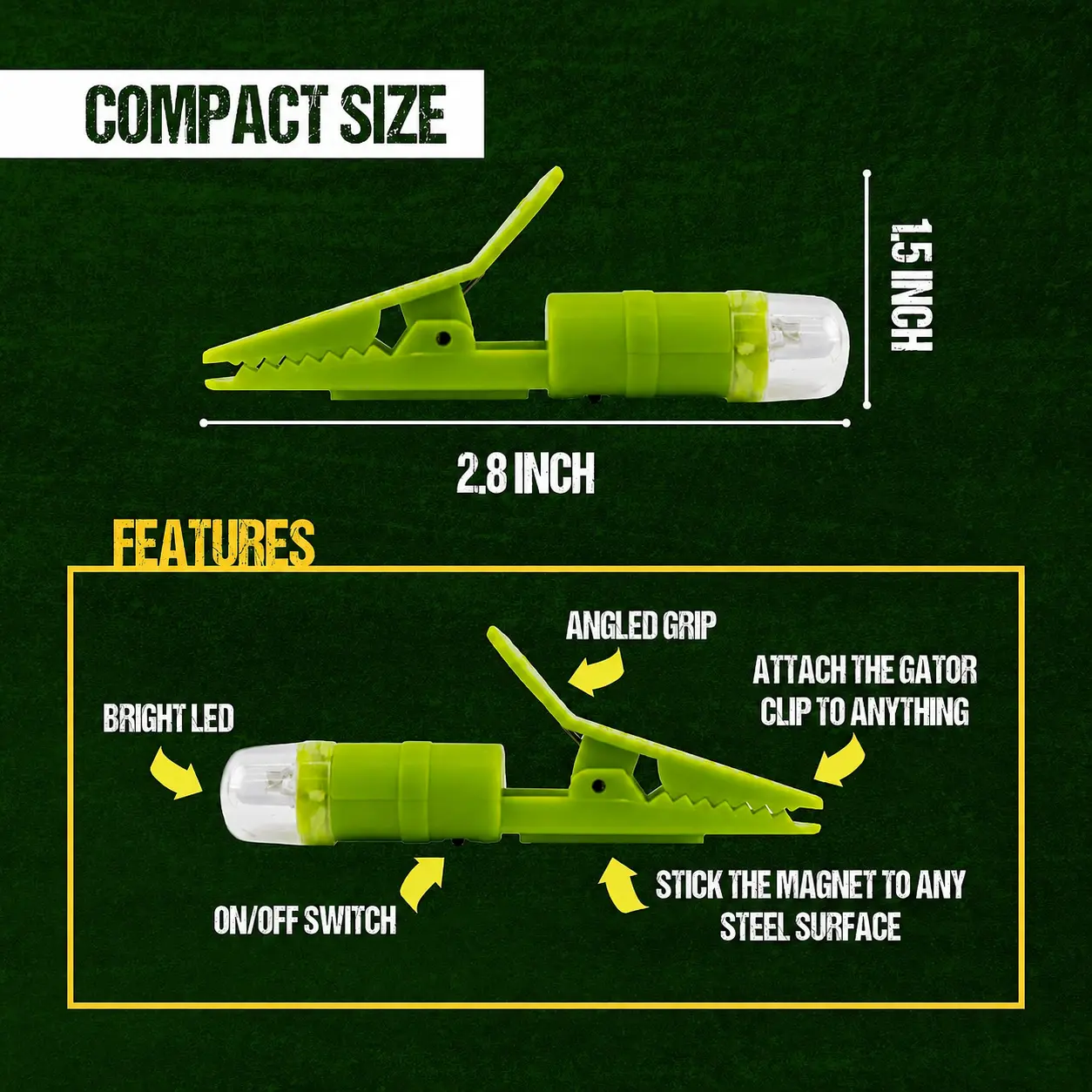
Gator Eyes are built around a different job than a premium rechargeable flashlight. At roughly 2.8 inches long and 1.5 inches tall, the goal is to make a useful LED light small enough to keep in several places—not one more device you have to move, charge, and remember.
Small enough to disappear into the places you already store gear.
The design combines a bright LED, three sealed LR41 alkaline button cells, a simple on/off switch, spring clip, and magnet in one compact body. The value is not any one feature. It is what those features let you do: put the light where your hands are working, then leave another one somewhere else.
Why Gator Eyes did not become a tiny version of every other flashlight.
Why not a replaceable battery?
The original team tried multiple ways to make the battery replaceable. Each solution required more housing, access, or hardware, and the light kept getting larger. At some point the “improvement” defeated the reason for the product. Gator Eyes stayed self-contained so the body could stay small. The current LR41 button-cell configuration is intentionally non-replaceable and was tested that way under UL 4200A:2023.
Why not make it rechargeable?
Rechargeability is useful when one light is your primary tool. Gator Eyes are designed for a different pattern: several inexpensive, compact utility lights stored at the point of need. Adding charging hardware would make the product larger and would turn a stash-and-forget location into another item that has to be brought back to a charger.
What does the magnet actually stick to?
The magnet is for ferrous surfaces such as many steel toolboxes, shelves, appliances, brackets, and vehicle components. Not every metal is magnetic—aluminum and many stainless-steel surfaces, for example, may not hold a magnet. If the surface is not magnetic, use the clip or choose another mounting point.
When is the clip better than the magnet?
The clip is useful on fabric, straps, pockets, bag edges, gear loops, blinds, branches, bins, and other places where there is no steel surface. It also lets you aim the light from a point close to the work instead of carrying the light in your hand.
Is a small light always the better light?
No. For long-distance illumination, long-duration work, or situations where maximum brightness is the priority, use a primary flashlight, lantern, or headlamp built for that job. Gator Eyes make sense for close utility work, backup use, fixed-point lighting, and marking—especially when size and placement matter more than raw output.
What does “disposable” mean here?
The LR41 alkaline button cells are not designed for user replacement or recharging. When the light reaches the end of its useful battery life, leave the housing intact and use the Gator Eyes recycling guide to find an appropriate local collection program. That responsible end-of-life step belongs beside the same compact-design tradeoff that keeps the light small.
Gator Eyes complement bigger lights instead of trying to beat them.
| Lighting tool | Best at | Where it shines | Where Gator Eyes differ |
|---|---|---|---|
| Full-size flashlight | Distance, longer tasks, higher output | Walking, searching, inspecting larger areas | Gator Eyes trade range and runtime for compact placement and hands-free mounting. |
| Headlamp | Hands-free light that follows your view | Moving, hiking, working continuously | Gator Eyes stay on the object or location, so the beam does not move every time your head does. |
| Lantern | Lighting a room or broad area | Power outages, campsites, shared spaces | Gator Eyes are point-of-need lights for drawers, panels, bags, bins, tools, and small tasks. |
| Gator Eyes | Compact, fixed-position utility and backup lighting | Glove boxes, storm kits, tackle trays, toolboxes, campers, packs, cabinets | The advantage is being small enough to keep multiple lights in the places where problems happen. |
When placement matters.
- You need both hands for a short task.
- You want a light already stored beside a breaker panel, toolbox, or gear bin.
- You need a compact glove-box, storm-kit, tackle-box, or camper light.
- You want a small marker you can leave at a known point and see again in low light.
- You would rather distribute several small lights than keep relocating one large light.
When output matters more than size.
- You need to illuminate a trail or large area for a long period.
- You need a primary work light for an extended repair.
- You need published waterproofing, runtime, or output specifications for a critical task.
- You need a rechargeable light for frequent daily use.
- You need a light designed to be your only emergency light source.
Less bulk. More places. Better odds the light is already there.
That is the design brief Gator Eyes kept—even after several attempts to make the product more complicated.
Disposable describes the battery design. It should not describe the disposal decision.
The sealed, non-rechargeable LR41 alkaline button-cell format is part of what keeps Gator Eyes compact. When a light is genuinely used up, the preferred next step is a battery/electronics, retailer take-back, or local collection program that accepts the intact device. Local rules vary, so check the recycling guide and your local solid-waste authority.
Use it fully. Leave it intact. Recycle it through the right program.
Local programs vary, so the recycling page includes current national resources and tells you what to confirm before making the trip.
How to Recycle Gator EyesUsed it up? Recycle it right.
Gator Eyes contain sealed, non-replaceable LR41 alkaline button cells. Leave the light intact and use a battery/electronics, retailer take-back, or local collection program that confirms it accepts the complete device. Local requirements vary.